

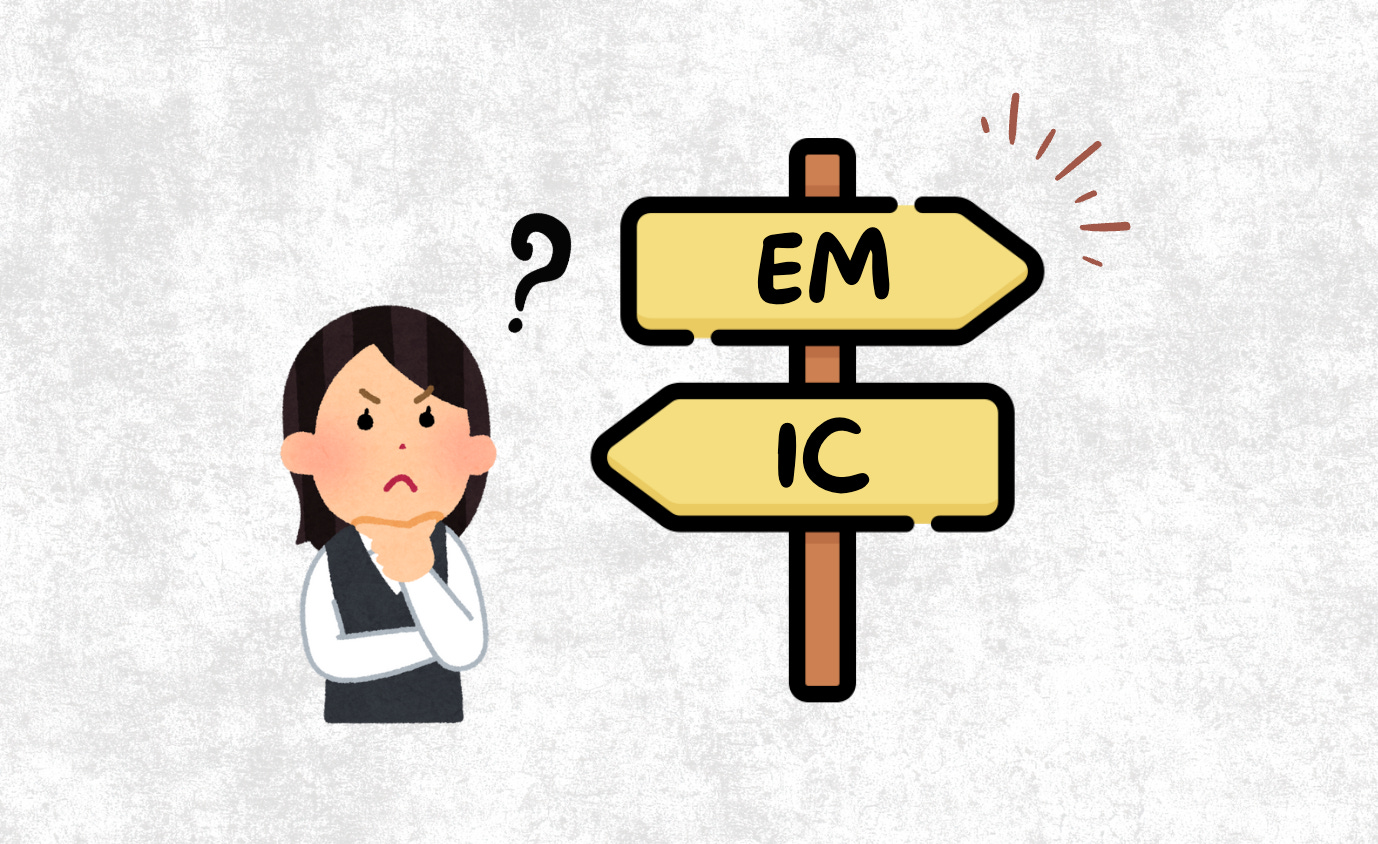
I get this question constantly from engineers thinking about their next career move: “Should I move into management?”
It’s a reasonable question, but slightly misleading.
The Real Question
When you try to label a decision as “good” or “bad,” you ignore the tradeoffs. Every option comes with downsides. A “good” decision doesn’t mean there are no downsides.
So the real question is: What are you optimizing for in the next 2-3 years?
Because once you understand what you’re actually trying to achieve, the IC versus management decision becomes a lot clearer.
So here’s how I look at it.
The Management Path Brings Advantages
I’m not going to pretend management is just a different flavor of the same job. It changes how you work and what opportunities become available to you.
Here’s what the management track actually gives you:
You Understand How Businesses Work
As an IC, you see projects from the execution side. You know what needs to be built and how to build it.
As a manager, you are involved with more business context. You are part of the decision before projects are brought to the engineers. You are also part of the discussions that connect projects with business outcomes and decide whether they’re worth doing.
This perspective is valuable whether you stay in management or not. Once you understand how managers think and what drives business decisions, you make better technical choices as an IC.
You Learn the Power Dynamics
Management exposes you to organizational politics in ways IC work never does.
You hate politics? Me too, but it’s there. And unfortunately, you usually need to get along with it to improve your impact level.
It’s tempting to believe that a well-designed idea will speak for itself. In reality, you usually need the right people to agree before anything moves forward.
As a manager, it’s much easier to see:
Which stakeholders actually have influence
How decisions really get made
Who you need to consult before proposing something
This doesn’t mean you have to play political games. For me, it simply means navigating the organization more effectively.
You Can Usually Go Back
Some managers return to IC role later, and many people don’t realize that. Management does not permanently lock you in.
I’ve seen plenty of managers return to IC roles later. Some missed coding. Some realized management wasn’t for them. Some wanted to look for different challenges.
As long as there’s an internal opening for the IC role, companies usually are flexible.
Trying different paths is rarely a bad idea. Maybe the management path is perfect for you.
The Management Path Also Brings Constraints
Let’s also be honest about what you’re giving up.
Management comes with real constraints that affect your career in ways most people don’t think about until they’re already committed.
You Need to Focus on a New Skill Set (and Less on Tech)
Management requires skills that have nothing to do with engineering.
Handling difficult conversations. Navigating organizational politics. Coaching people through performance issues. Managing budgets. Balancing competing stakeholder demands.
These skills are valuable. But learning them takes time and energy. That time comes directly out of technical work.
Every hour spent on management skills is an hour not spent on system design or technical depth.
For example, if you plan to target FAANG-level companies later, most still rely on LeetCode-style and system-design interviews. ICs tend to practice these continuously. Managers often have to relearn and practice from scratch.
That’s fine if management is where you want to be. It’s a problem if you thought you’d keep both skill sets equally sharp.
Your Responsibilities Become Fixed
IC roles like Staff and Principal Engineers have more flexible. Their role adapts with the company’s technical needs. You might be embedded in one team to help them get on track today, but move on to lead another cross-team project tomorrow. This brings a lot of variation, surprises, and challenges to work.
As a manager, your growth path is clear: manage more people.
The corporate ladder for managers is well-defined: Engineering Manager → Senior EM → Director → VP → C-level. Each step means more direct reports, bigger teams, broader scope.
Your impact becomes defined by planning, execution, retrospectives, conflict resolution, and people problems. They can start to feel repetitive if you don’t actively look for other meaningful work yourself.
The Job Market Is Smaller (And Harder to Navigate)
One uncomfortable truth is: There are fewer management roles than IC roles.
A typical engineering organization has one manager for every 6-8 engineers. That’s 6-8 IC openings vs 1 EM opening. Companies also prefer internal candidates because management hires carry higher risk.
And just like IC roles, there are “good” roles and “bad” management roles. There are “good” roles at companies with solid engineering culture, reasonable expectations, and growth opportunities. Those usually go to people with connections. So you can start to imagine how challenging it is to find a good management job.
By contrast, this is not a big problem for IC roles. Staff and Principal engineers are still rare. If you’re good, companies actively look to you.
As a result, job hunting for management roles usually takes longer.
Start Asking What You’re Optimizing For
Many engineers went into management because it seemed like “the next step”. Two years later, they realize they never wanted to do it at the first place.
Others stayed IC because management seemed stressful. Three years later, they realize that they should have started earlier.
So “IC vs EM” is the wrong question. The real questions are:
What are you actually trying to achieve in the next 2-3 years?
What kind of impact matters to you?
What trade-offs are you willing to make?
Once you know those, the path becomes obvious.
If You Want Clarity
If you need help figuring that out, I’m here to help. I offer Career Decision Consulting for engineers at exactly this crossroads. It’s based on my own experience and how I helped other engineers make such decisions.
We’ll work through your goals, evaluate your options, and build a plan that makes sense for where you actually want to go.
Let’s map out your next move together :)
That’s it for today.
If this resonated, feel free to like or share it.
I’ll see you in the next post.
Adler from Tokyo Tech Lead
Great post. The best (only?) way to know if you're cut out for a management path is giving it a try.
Since it is a reversible decision, I often advice people to just go for it, after educating them about what the role looks like in practice.