

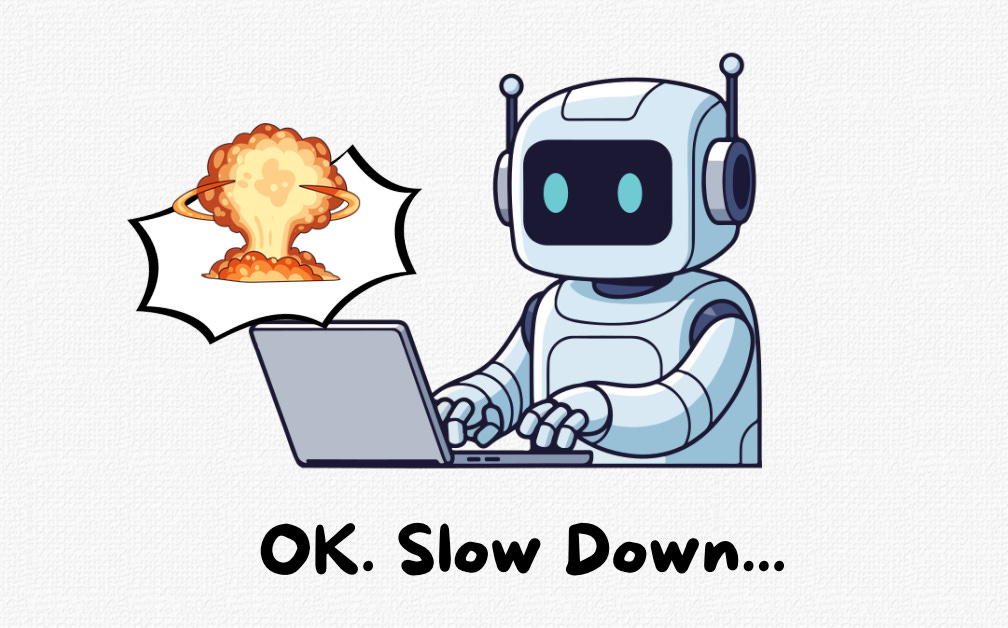
Moving Too Fast with AI Can Backfire
Earlier this month, Amazon rolled out a new policy: any AI-generated code now requires a senior developer to sign off before it goes into production.
It’s funny because Amazon is also one of the pioneers in driving the AI-first development forward.
It’s a reminder that moving too fast with AI could bring more incidents. A lot of them. Amazon knows this, and GitHub knows this, too.
It also proves that we’re still not at the stage where AI can completely replace software engineers. For now, humans are still the bottleneck.
In this post, I want to dig into what that actually means for your career as an engineer in 2026.
Why AI Won’t Replace Engineers Anytime Soon
The “AI will replace engineers” argument usually focuses on one thing: AI can write code.
But writing code has never been the hard part of software engineering. The hard part is everything surrounding the code, and AI isn’t close to replacing any of that.
Someone Has to Own the Outcome
I’ve seen AI-generated code that looked clean, passed review, and made it to production. But it missed some edge cases in the system, then it caused an incident.
When the postmortem happened, nobody blamed the AI. We blamed the engineer who approved it.
That’s the reality of how accountability works in software teams. AI doesn’t get paged at 2am. AI doesn’t write the incident report. AI doesn’t explain to your manager what went wrong and what you’re doing to prevent it from happening again. A human does.
This is exactly what Amazon’s policy formalizes: the human who signs off is the one who owns the outcome. AI is a tool. Ownership stays with the person.
Ownership is exactly the gap I help close in Your Path to Senior Engineer: an 1:1 session to figure out what's standing between you and the senior mindset.
Most Problems Aren’t Even Software Problems
The majority of project failures aren’t caused by bad code quality. They come from everything else.
Requirements that changed three times in a single month
A legacy system nobody fully understood
Legal or political constraints from compliance, security, or finance
These aren’t problems you can prompt your way out of. They require understanding the organization, the history, and the people involved.
That’s the work senior engineers do. And it has very little to do with coding.
What AI Is Changing
Let me be clear: I’m not here to downplay what AI can do.
The tools have gotten genuinely good. I use them myself. The engineers on my team use them. And the way we work has already shifted in ways that I don’t think are going back.
We Spend More Time Gatekeeping
Two years ago, AI coding tools were mostly autocomplete with better context. Now they’re doing most of the execution. It’s now mostly AI-DLC.
Engineers are using AI to pressure-test requirements, generate edge cases, and draft technical specs. AI can sketch out architecture options and flag tradeoffs. We also let them handle most of the coding and code review.
The pattern across all of these is consistent: less time executing, more time reviewing.
That shift sounds like a good thing. But it also changes what the job demands.
The Productivity Bar Has Moved
With AI, the expectation of what one engineer can produce in a given time has gone up. Not officially, in most places. But in practice, yes.
For individual engineers, this means the definition of “creating enough value” has changed. Doing what used to be considered solid output is now closer to the minimum. The engineers who stand out are the ones who use AI to amplify their impact across the team.
AI Becomes an Excuse of Layoffs
I’m fortunate enough to be able to work in Japan where layoffs are less common. But for the rest of the world, it’s changing fast.
Companies are actively trying to replace people with AI, and the number of jobs has gone down sharply, especially for entry-level jobs. It’s mainly because of the interest rate change, but AI becomes a convenient entry point for this cost reduction initiative.
Every time managers request a new headcount, we get pushback: “Can we use AI to finish the job?”
Software Engineers’ Skills that Matter Now
So if AI is handling more of the execution, what does a valuable engineer actually look like in 2026?
Two things stand out to me.
Technical Depth Matters More
There’s a misconception that AI makes technical knowledge less important.
I’d argue the opposite.
When you’re writing code from scratch, your mistakes are usually visible to you. You know what you don’t know. But when AI generates code confidently and fluently, the errors are much harder to spot. You need a stronger foundation to evaluate the output.
In practice, this shows up in two ways.
Identifying hallucinations. AI models make things up. Not always obviously. Sometimes it’s code that works on its own but breaks in the specific context. Catching these requires genuine technical understanding. You can’t evaluate what you don’t understand.
Knowing when the output is actually good. In addition to spotting errors, engineers also need to know when the AI’s solution is suboptimal, and when the approach works but will cause maintenance problems later. That judgment comes from experience and breadth.
Soft Skills AI Can’t Replicate
Teamwork, collaboration, and navigating politics. Getting a feature shipped often has more to do with alignment, negotiation, and knowing when to push and when to let something go. AI can’t sit in a tense cross-team meeting and read the room. It can’t figure out the politics behind a decision.
These skills have always mattered. They matter more now, because the execution gap between engineers is narrowing. What differentiates people increasingly comes down to how well they work with others.
Ownership mindset. Ownership means you don’t stop at “my part is done.” You care about the outcome. You flag risks early. You take accountability when something breaks, even if it wasn’t entirely your fault.
AI doesn’t own anything. It responds to prompts and moves on. The engineer who takes responsibility for the result, from requirements through production, is doing something the tool fundamentally cannot.
Last Words
Amazon’s policy is a small signal, but it points at the trend.
The companies building with AI need humans to be accountable. They are also raising the bar for what those humans need to bring.
If you’re a mid-level engineer reading this, I don’t think you should be worried about being replaced. I think you should be thinking about what you’re building toward.
Moving forward, the senior engineer who stands out is someone who thinks deeply, communicates more effectively, and takes responsibility more consistently.
If you’re working hard to adopt AI, but not sure whether you’re in the right direction, that’s exactly what I help with in Your Path to Senior Engineer, a 1:1 session where we figure out what’s actually standing between you and the senior mindset.
I’ll see you in the next post.
Adler from Tokyo Tech Lead