

Your performance review always starts with a form, asking you about:
“What did you accomplish this year? What expectations from the career ladder that you have fulfilled?” You fill it out honestly, focused on your own work.
So it makes sense to think the review is about you.
On my side of the table, the form looks different. It’s a list of names, yours sitting next to everyone else’s. For me, in addition to deciding whether you did well, I also need to decide how you compare to the people around you.
Rating is a comparison. Where you sit depends on how your work stacks up against the team, and sometimes against engineers on other teams.
So here’s how is it decided:
Timeline: What Happens In A Cycle
Most engineers picture the review process as a straight line: do the work, get rated, hear the feedback. Simple.
Yes, from your perspective, it’s correct.
Now let’s dive into how your manager sees it:
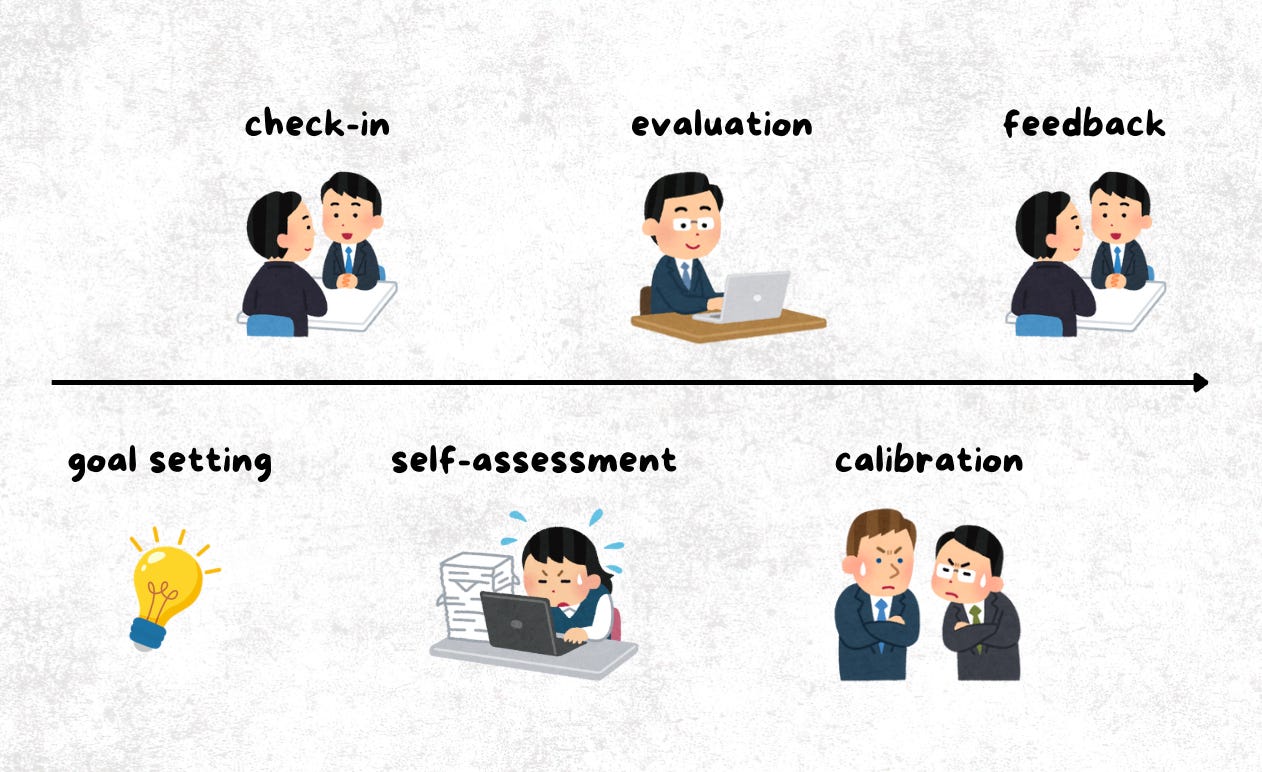
The cycle starts with you and your manager setting them together (if your company has this process). From there, your manager spends the rest of the cycle forming a working impression of you. You might have regular check-ins to review your goals. Other than that, you focus on doing your work.
When review season arrives, managers collect your self-assessment and peer feedback. Then they draft a rating on their own. That draft goes into a calibration meeting with other managers and HR. After several rounds of discussion, the rating gets adjusted and approved.
After all that, you sit down with your manager for the feedback conversation.
So by the time you’re in that feedback conversation, the decision has already been made and signed off. The meeting you’ve been dreading is where it gets delivered. That’s the reason why ratings rarely change even if you’re not happy about it.
There are rare exceptions, though. It usually takes a major mistake on your manager’s part to trigger it. Fixing it means your manager putting their own rating on the line to argue for yours. I don’t see that happen often.
What Managers Write on the Evaluation Form
Some engineers assume the self-assessment is the document their manager uses to write feedback. It isn’t. There’s usually a separate evaluation form.
A typical form breaks down into four sections:
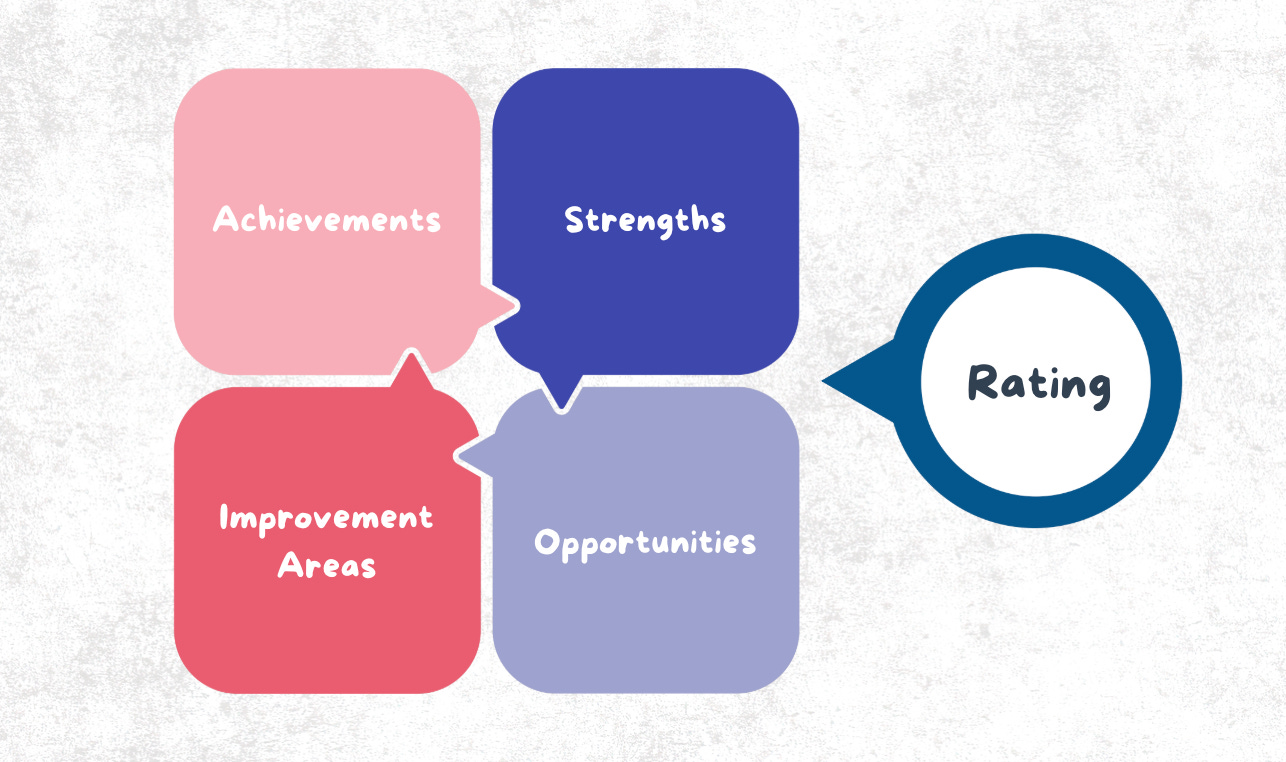
Achievements covers what you contributed this cycle, such as projects and bug-fixes.
Strengths covers the behaviors worth praising, usually measured against the company’s career ladder if one exists. If you’re a mid-level engineer who designed a working solution for a complex system issue, that goes into the section.
Improvement areas covers the opposite: behaviors that aren’t encouraged. For example, skipping meetings without explanation is a red flag that goes into this section. Don’t laugh. I’ve seen more than a few people who still need to work on basic work ethics.
Opportunities is a forward-looking section. In addition to the improvement areas, managers might write down other opportunities that fit you. It’s more of a brainstorming space, and doesn’t get used in calibration.
Once all four sections are filled in, the manager decides a rating: either exceeding, meeting, or not meeting expectations. And they have to be ready to justify and defend it. That means walking into the calibration meetings with examples and stories.
This form is exactly what your brag doc is feeding. A strong brag doc makes your manager’s job easier when they sit down to write this.
Calibration and What Usually Happens
After you submit your self-assessment, managers disappear behind the curtain for a few weeks. They align. They argue. This is why your rating doesn’t show up right after you submit your self-assessment.
A lot can happen during the calibration meetings.
It’s common for managers to want to promote their people as much as possible. Their team members work hard, they’re close to them, and that’s how a good working relationship tends to go. But the room is also made up with managers who don’t know you. For everyone else, the job is to evaluate whether the rating is reasonable.
Some managers walk in without much. I’ve seen managers who didn’t have real materials or proof behind them, only vague praise. They commented that “this project was hard,” and when someone asked how hard exactly, they couldn’t explain the details. That kind of argument rarely survives.
On the opposite, some managers come in prepared. They have specific “selling points” that map to specific ladder expectations, “navigated a difficult stakeholder conversation,” “introduced a new technology to the team,” each requirement backed by a real example. It’s hard to do this well, and it comes down to whether the manager is good at it and whether they kept the material to back it up.
Then there are the political problems. Rigid managers will insist that anyone who hasn't completed a full cycle gets a flat "Meets Expectations." I've watched managers fight for a great new hire, arguing the person came in under-leveled. It usually gets pushed back, with the reason that "others who've been here longer have more impact". Eventually, the manager gives up and watches the rating drop. It's not fair, but it happens.
Everything here is about whether your manager can turn your work into a case that survives calibration. Note that calibration does not need to be a meeting of 10 other managers. It could be your manager talking to their manager and justifying their ratings in their 1-on-1 meetings.
The outcome depends on what your manager wrote down before the calibration, and how prepared they were to defend it.
Last Words
So this is how performance review works.
You don’t sit in on your calibration meeting. You don’t rewrite your manager’s evaluation form. But you can control what your manager has to work with.
In the next post, I’ll be covering what managers care about when writing performance reviews, and how you can build a strong track record accordingly. Stay tuned!
Thanks for reading this post!
I’m currently writing my Performance Review Survival Guide, which goes deeper into all of this. It’s a short ebook told from the manager’s perspective: what we look at, and what most engineers miss.
Before I finalize it, I have one question for you:
💡 What’s the one thing about performance reviews you’ve always wanted to understand from your manager’s side?
Drop it in the comments or reply to this email. I read every one.
See you in the next post.
Adler from Tokyo Tech Lead