

Early in my career as an engineer, a peer said something that stuck with me.
“Isn’t performance review the manager’s job? Why do we have to write a self-assessment? They should already know everything.”
At the time, I thought they had a point.
Now I’m a manager, and every manager I know has the same problem at review time: too many engineers, not enough specific memories. When there’s not enough evidence, I’m working from memory. And memory is selective.
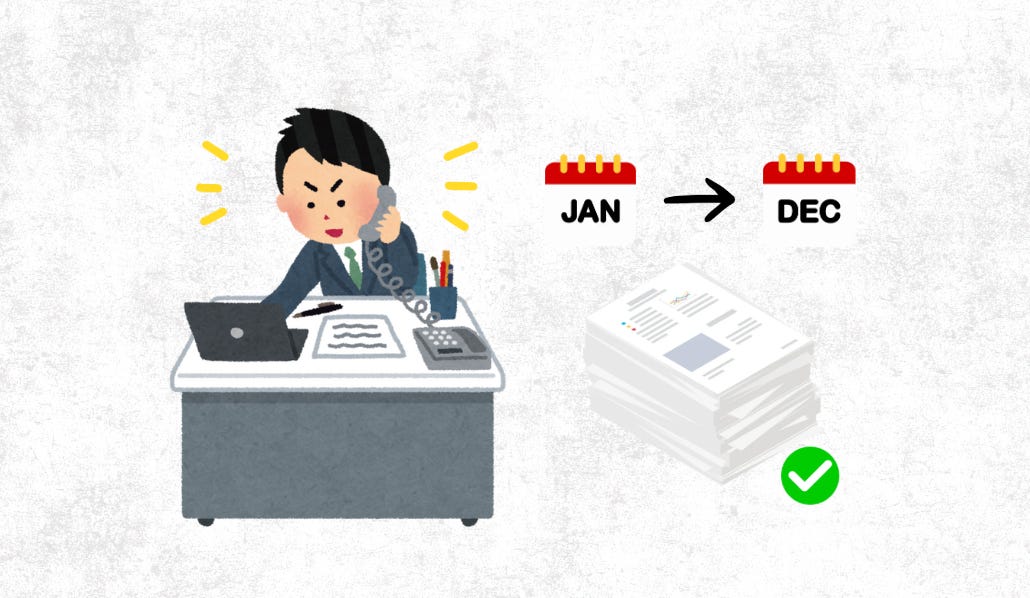
That’s the answer to my peer’s question. And it’s why engineers need to actively prepare for review season instead of waiting for their manager to act: to align with their goal, and to keep their memory fresh.
Set Personal Goals at the Beginning of the Cycle
The first thing to do at the start of every review cycle is to ask your manager directly: “What does Exceeds Expectations look like for someone at my level this cycle?” Don’t assume the bar is obvious. Every manager has their own standard.
Likewise, every team has a different focus area. A team managing internal tools has stricter requirements around security and access control, while a consumer-facing team focuses more on scale and stability. Your goals need to reflect your team’s focus area at that time. A universal engineering ladder doesn’t apply the same way across different teams.
I had a team member who spent a lot of time cutting server costs through auto-scaling and caching. They successfully cut costs down by 20%. But our team handled internal tools, and our server costs were less than 1% compared to client-facing systems. That work didn’t create much impact in calibration. If I had had a conversation at the start with that member, I would have redirected them toward something different.
Another point is to identify what your manager and their manager care about. Yes, technically interesting tasks are fun to do, but your manager might see it differently. You could work on a boring task that improves regression testing coverage for a frequently changed area. And that could be more impactful than digging deep into an idempotency issue that happens only once in a year.
Bonus point: Align your goals with what the business is trying to do this year. Did the CEO talk a lot about AI adoption during All-Hands meetings? Or did VPs focus on cost reduction? The focus shifts regularly, and your manager’s priorities shift with it. Those goals carry more weight in calibration than others that only affect yourself. Ask your manager: what does the business care about now? Then make sure your work is tied to that.
Use Personal Goals as Directions, Not Checklists
When engineers are too attached to their original list, they miss opportunities that would have changed their rating. For example, you might not have planned to mentor anyone. Then someone on your team resigns and a junior dev joins as backfill. That’s an opportunity you can claim, one that adds real value to your next review. I once had a member who turned it down simply because mentorship wasn’t on his checklist. From my perspective, it could have filled a major gap on his career ladder.
The same logic applies when projects get cancelled. If you’re left with a few weeks waiting for the next one and you just wait, you’ll have a gap in your contributions. A better move is to pick up technical debt from the backlog, or ask your manager for something equally impactful to fill that window.
The goals you set at the start of the cycle will drift. Projects get cancelled, priorities shift, new opportunities appear. Some engineers treat their personal goals as a checklist, and those are the only items that matter for the entire cycle. From a manager’s perspective, this is a mistake.
Your goals are a starting direction. Stay open to what actually comes up during the cycle.
Keep a Brag Doc
Use your 1-on-1 doc to keep a track of what you’ve done. Update it every week or two, tied to your regular meeting cadence.
A useful signal: if you start writing and nothing comes to mind, pay attention to that. Are you working on something your manager probably doesn’t care about? Are you stuck on one issue for so long that nothing else is getting done? It’s a good time to do a personal retrospect.
There are two types of entries worth tracking:
Quantitative: things with visible, measurable impact. How much time a process saves the team, how much revenue a feature contributed, how many incidents were prevented. Numbers make calibration conversations easier.
Qualitative: contributions that don’t translate to numbers but still demonstrate value. Resolving a cross-team conflict, setting directions in an ambiguous project, unblocking a colleague who was stuck.
One common pattern I see is engineers leaning too heavily on qualitative contributions. They help the team constantly, but none of it connects to any team metric. This creates an output vs. outcome problem.
Likewise, it creates its own blind spot if focusing only on tasks with clear business impacts, while ignoring things such as mentorship or answering teammates’ questions.
The goal is balance:
Quantitative entries show business impact
Qualitative entries show behavior
When it is done properly and regularly, you already have everything when review season starts. The self-assessment becomes an editing job where you pick the highlights from all your previous work.
Conduct Regular Reviews with Your Manager
Don’t wait for review season to find out if you’re on track. Set regular (e.g, quarterly) check-ins with your manager specifically to review your progress and direction.
Most managers won’t set this up for you because their plates are already full. More direct reports and more responsibilities. If this isn’t already on your manager’s agenda, put it there yourself. In my experience, engineers who do this almost always benefit from it. It shows ambition, and it gives your manager a chance to flag anything before it becomes a problem.
These check-ins protect you from surprise feedback. If something is off, you want to hear it in month two, not in the review meeting.
It also helps you adjust your direction by asking two questions:
“Is there anything I should be doing differently?”
“Are there new things I should add to my goals, or anything I should drop?”
Your manager has context you don’t. They know what’s happening in the team and with the upper management. Getting their input regularly keeps your efforts aligned with what will matter.
Know What Your Peers Think of You
I once missed an issue where I ignored project assignment and assumed that the team would pick up on their own. Some members were not happy about it, but they didn’t say anything. This was picked up by one team member who was kind enough to mention it in a Google Form I sent them. Without that, I probably would have made the same mistake again.
When ask for peer review, keep in mind that most peers are nice and won’t provide honest feedback. That’s ok. Sometimes you’ll find people who are kind enough to provide real feedback. As long as you ask from those you’ve been working closely with, they will have something to say.
If your company includes formal peer review, don’t wait until review season to ask for feedback. Ask your peers regularly throughout the cycle, similar to how you ask your manager for regular feedback. If you don’t feel comfortable inviting them to a 1-on-1 meeting, it’s ok to do it on Slack or an anonymous Google Form. The point is to know what others think of you before the formal review.
Last Words
If you’re doing it for the first time, yes it will take some effort. But after you build this habit, it naturally becomes part of your workflow that helps you move forward.
Pick one item. Start building the habit from today.
Thanks for reading this post!
I’m currently writing my Performance Review Survival Guide, which goes deeper into all of this. It’s a short ebook told from the manager’s perspective: what we look at, and what most engineers miss.
Before I finalize it, I have one question for you:
💡 What’s the one thing about performance reviews you’ve always wanted to understand from your manager’s side?
Send me a message or reply to this email. I read every one.