


When I was an engineer, I had a few performance review surprises.
There were times I felt I had clearly exceeded expectations, but still just “Meet Expectations.” And even on a few occasions, I got “Not Meeting Expectations” after a year of fighting hard.
I argued with my manager and pushed back.
It was never successful. The response I got went something like this: “There are 1-2 areas where you fell short.” That was it. The twenty other things I had done well were barely acknowledged. It was unfair and frustrating.
A few years later, I became a manager, and I finally understood what was actually happening.
Behind every calibration meeting, there’s a process that most engineers never see. There is a quota system set by upper management. I had never heard of it until the first time I sat on that side of the table.
That system is called forced distribution. Once you know it exists, a lot of confusing performance conversations start to make sense.
What’s Forced Distribution?
Forced distribution is a performance rating system where managers are required to spread their team’s ratings across a curve.
Think of it like grading on a curve in school. No matter how the class performed, only a certain percentage can get an A, a certain percentage get a B, and someone has to get a C. The same logic applies here. A fixed quota of employees must land in each rating bucket, regardless of actual performance.
A typical forced distribution might look like this:
Top performers (Exceeds Expectations): 10-20%
Solid performers (Meets Expectations): 60-70%
Low performers (Not Meeting Expectations): 10-20%
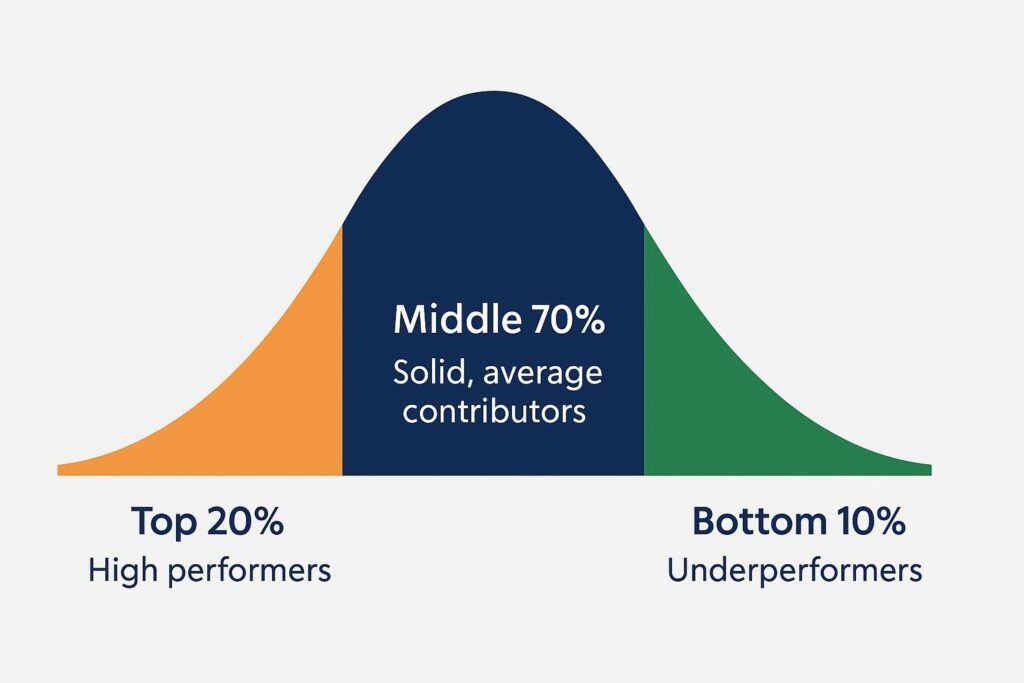
The exact numbers vary by company. But the structure is the same: the curve is pre-set, and the ratings have to fit inside it.
Why Do Companies Do This?
There are two main reasons.
Some in upper management genuinely believe this reflects reality. They believes that in any group, performance naturally distributes across a bell curve. Forced ratings just make that visible. It also avoids “rating inflation” because managers tend to consider their team members high performers due to their close work relationship.
The more honest reason is budget control. Salary increases, bonuses, and promotions are tied to performance ratings. If everyone gets a “Exceeds Expectations”, compensation costs go up fast. Forced distribution keeps those costs predictable. A fixed percentage at the top means a fixed percentage getting raises. The math works out for finance.
How to Tell If Your Company Uses It
Most companies that use forced distribution don’t advertise it. If engineers knew their rating was partially determined by a quota, it would create frustration and retention problems. So the default is to keep it at the management level.
That said, you have a few ways to find out.
Check HR documents first. Some companies make their evaluation framework public internally. If yours does, look for language around “calibration” and “rating distribution”. While the system is unfair, we still appreciate companies which are honest about it.
Ask your manager directly. This sounds uncomfortable, but it’s a legitimate question. Something like: “Does our company have any guidelines around how ratings are distributed across the team?” Most managers won’t lie outright.
If it’s not public, listen to how your manager explains your rating. Two patterns show up regularly:
They acknowledge your work, but can’t justify the rating. Your manager agrees you did good work but still gives you a low rating with a weak explanation. The effort and the outcome don’t connect.
They shift the blame upward. Phrases like “HR adjusted the results” or “I fought for you but failed” are signals. A manager who can fully justify a rating doesn’t need to blame someone else.
How to Navigate a Forced Distribution System
Once I know it exists, here’s what I’d actually do:
Visibility Matters More
In a forced distribution environment, your manager has to defend your rating in a room full of other managers. If they can’t explain clearly what you’ve done, you’re easy to move down. Your job is to make their job easier.
A few habits that help (not exhaustive):
Keep a running brag doc. Log your contributions, wins, and impact as they happen, not two weeks before review season.
Document failures and what you did to recover. Managers who can show growth have an easier case to make.
Share updates proactively. Regular visibility means they’re never starting from scratch when it counts.
Change How You Measure Yourself Against Others
Career or engineering ladders describe what the next level looks like in abstract terms. They’re useful as a reference, but they’re hard to act on. A more practical frame: find someone in your environment who is already at the level you’re aiming for, and benchmark against them.
Ask your manager: “Who would be my role model for my next step?” That’s a much more concrete step to move forward. In a relative ranking system, knowing where you are in the team is as important as knowing what’s next on the career ladder.
Keep an Exit Strategy
If your manager consistently can’t advocate for you in calibration, your ceiling in that team is low regardless of how hard you work.
That means you need to keep your options open. If you’re considering an internal move, start talking to members outside the team. Look for a team where there’s more room to stand out, or a manager with a stronger track record of advocating for their members.
If you’re considering leaving the company, start building connections, maintain active in tech events, and keep your resume up-to-date. You might want to start taking action if a certain performance review goes wildly different from your expectation.
What I’d Be Cautious About
A few things I’d avoid, even when the system feels unfair.
Gaming the Ranking Don’t Help Your Career
I used to think about it too: If ratings are relative, why not move to a weaker team where you’d naturally stand out?
But think twice before you act.
Moving to a weaker team puts you in an environment with less to learn from. You might get a better rating in the short term, but your actual skills stagnate. You no longer have strong engineers in the team to be your role model. And when you eventually want to move on, the gap shows. Interviewers and future managers will notice.
Leaving Has Its Own Risks
Changing companies feels like a clean solution. New environment and fresh start. But forced distribution is widespread enough that you’re likely to encounter it again. HR teams in interviews will almost never confirm it. “We don’t do that here” is a common answer, and it’s not always accurate.
On top of that, it’s also riskier to change jobs in this era. If you’re going to make a move, make sure it’s because of a better environment and you understand the risks.
Last Words
Forced distribution is confusing when you’re in the middle of it. Hopefully this post gives you a clearer picture of what’s actually happening behind the scenes, and a more grounded way to respond to it.
A few things worth keeping in mind:
The rating isn’t always a reflection of your performance. Understand the system.
Visibility and advocacy matter more in a quota-based environment. Make it easy for your manager to fight for you.
Benchmark against real people around you, in addition to the career ladder.
Keep your options open, but move for the right reasons.
And there’s one more thing.
I’m currently writing my Performance Review Survival Guide that goes deeper into all of this. The goal is simple: help engineers understand what their managers are actually looking at during reviews, so their work stops getting overlooked.
It’s a short ebook told from the manager’s perspective. What we look at, and what most engineers miss.
💡 If you’re interested in getting early access for free and work with me to review and provide feedback, reply to this email or leave a comment. I’ll reach out personally when it’s ready.
See you in the next post.
Adler from Tokyo Tech Lead